
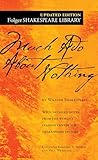
Much ado about nothing / William Shakespeare ; Barbara A. Mowat, editor.
By: Shakespeare, William.
Contributor(s): Mowat, Barbara [editor] | Westine, Paul [editor].
Material type: MusicSeries: New Folger library Shakespeare.New York, NY : Washington Square Press, ©1995Description: lv, 246 pages ; 18 cm.Content type: text Media type: unmediated Carrier type: volumeISBN: 9780743482752.Subject(s): Rejection -- (Psychology) -- Drama | Conspiracies -- Drama | Courtship -- DramaDDC Call Number: FIC | Sh152m 1995
 | Item type | Current location | Call number | Status | Date due | Barcode |
|---|---|---|---|---|---|
 Fiction
|
APEC Calumpang Library Fiction | FIC Sh152m 1995 (Browse shelf) | Available | B10-0000015 | |
|
Fiction
|
APEC Doña Juana Library Fiction | FIC Sh152m 1995 (Browse shelf) | Available | A02-0000016 | |
|
Fiction
|
APEC España Library Fiction | FIC Sh152m 1995 (Browse shelf) | Available | B11-0000015 | |
|
Fiction
|
APEC G. Tuazon Library Fiction | FIC Sh152m 1995 (Browse shelf) | Available | B05-0000015 | |
|
Fiction
|
APEC Holy Spirit Library
|
FIC Sh152m 1995 (Browse shelf) | Available | A03-0000016 | |
|
Fiction
|
APEC JRU Lipa Library Fiction | FIC Sh152m 1995 (Browse shelf) | Available | B12-0000066 | |
|
Fiction
|
APEC North Fairview Library Fiction | FIC Sh152m 1995 (Browse shelf) | Available | A04-0000016 | |
|
Fiction
|
APEC Ortigas Extension, Cainta Library Fiction | FIC Sh152m 1995 (Browse shelf) | Available | B09-0000066 | |
|
Fiction
|
APEC Silangan, Pateros Library Fiction | FIC Sh152m 1995 (Browse shelf) | Available | B07-0000015 | |
|
Fiction
|
APEC Taytay Library Fiction | FIC Sh152m 1995 (Browse shelf) | Available | B08-0000065 | |
|
Fiction
|
APEC V. Luna Library Fiction | FIC Sh152m 1995 (Browse shelf) | Available | A01-0000016 |

Commentary throughout by John Mauceri -- Short clips of motion picture and other music throughout -- Adventures of Robin Hood. Battle, victor, and epilogue scene / Korngold (3:55) (from commercial compact disc) -- Adventures of Robin Hood. Fanfare and love scene / Korngold (7:11) (from commercial compact disc) -- Much ado about nothing, op. 11. Maiden in the bridal chamber. March of the sentinel. Hornpipe / Korngold (Junko Ohtsu, violinist ; Maureen Wallis, pianist) (originally recorded Dec. 5, 1981, in the Coolidge Auditorium of the Library of Congress, Washington, D.C.) -- Trio, no. 1, D major / Korngold (Beaux Arts Trio) (31:00) (originally recorded in the auditorium of the National Academy of Sciences, Dec. 2, 1993).
"Much Ado About Nothing is one of Shakespeare's most frequently performed comedies. Probably written in the latter part of 1598, it was performed soon afterward by the Lord Chamberlain's Men, the theatrical company in which William Shakespeare had a business interest separate from his duties as actor and playwright.
Much Ado is apparently based on a story in a collection of stories by Italian writer Matteo Bandello, originally published in 1554 and translated into English in 1582. Some plot elements and characters may have been inspired by a lengthy Italian poem, Orlando Furioso by Ludovico Aristo, originally published in 1532 and translated into English in 1591.
The broad comedy in Much Ado has early twentieth-century parallels in the romantic "screwball" comedies of the 1930s — for example, It Happened One Night with Clark Gable and Claudette Colbert, Ninotchka with Greta Garbo and Melvin Douglas, and The Awful Truth with Cary Grant and Irene Dunne. The scenes with Dogberry and his men find ready counterparts in early movies featuring the Keystone Kops and the Marx Brothers.
If Much Ado were only a play depicting its characters as products of their circumstances and the situations they encounter, the play would seem quite shallow and would probably not be popular today. However, most of the complications and problems are resolved through psychological growth in several characters rather than merely through changes in circumstances (see the Character Analyses later in this study guide).
Most Shakespeare authorities agree that the word "nothing" in the play's title is purposely ambiguous. In Elizabethan times, "nothing" was pronounced much like "noting," which means not only taking note or observing, but also overhearing or intentionally eavesdropping — actions around which the plot turns and twists."--
There are no comments for this item.